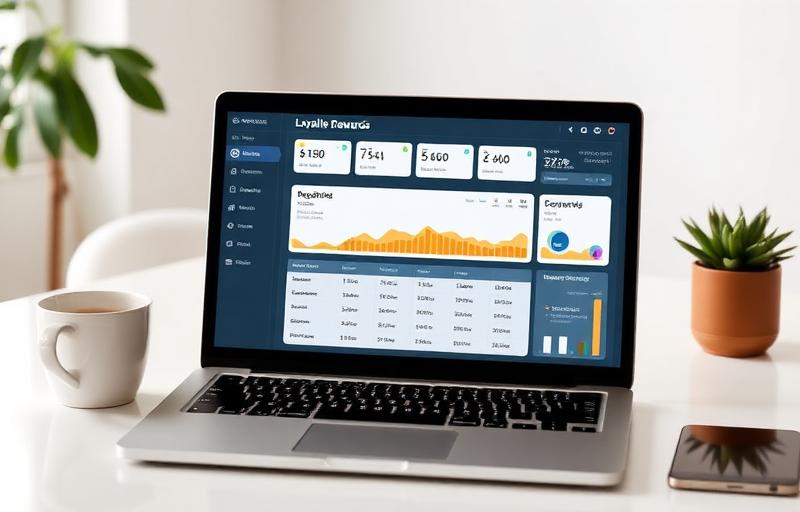
Loyalty Dashboards: What Your Customers Really Want to See
You've built a loyalty program. But if customers can't easily see how many points they have, how close they are to their next reward, and what's available to them right now — your program is invisible. The loyalty dashboard is where your program either becomes a daily engagement tool or a forgotten account setting. Getting it right is one of the highest-leverage UX decisions you'll make in your loyalty program design.
Build a loyalty program your customers will actually use
See Loop.fans Loyalty & RewardsWhat Customers Actually Want to See
Want to calculate the ROI of a loyalty program? Try our free loyalty ROI calculator — See the revenue impact in minutes.
Loyalty dashboard research consistently reveals the same customer priorities. For more on this, see our guide to customer lifetime value formula. In order of importance:
- Current points balance — immediately visible on dashboard launch, prominently displayed
- Progress to next reward — the most motivating display; a progress bar showing how close they are to something
- Available rewards right now — what can they get today? If they can redeem, show them how
- Recent earning activity — what did they earn recently? Reinforces positive association with earning actions
- Tier status — current tier and requirements for next tier
Secondary features that add value: referral dashboard, challenges and missions, community feed, exclusive content access. For more on this, see our guide to customer retention software. These belong one navigation tap away — not on the primary screen.
The mistake most brands make is cluttering the primary view with secondary features while burying the points balance. For more on this, see our guide to loyalty program ideas. Every second a customer spends looking for their balance is a second they're considering whether this program is worth engaging with.
The Progress Bar: Your Most Powerful Loyalty UI Element
Nothing in loyalty dashboard UX drives behavior as consistently as a well-designed progress bar. The psychological mechanic is called "goal gradient effect" — the closer people are to completing a goal, the more motivated they become to complete it. A customer who is 50 points away from their next reward is more likely to make an incremental purchase than one who is 500 points away, even if the reward is the same.
Implementing this effectively:
- Show the progress bar prominently, above the fold on every dashboard view
- Frame it as "X points until your next reward" not "Y points earned" — forward-looking framing outperforms backward-looking framing
- Make the bar color-change as it fills — visual feedback that progress is happening
- When a customer is close to a reward, send a notification: "You're 50 points from Gold — here's how to get there today"
Transparency Builds Trust (and Drives Engagement)
A common loyalty program failure mode: customers earn points but don't understand how the math works. They can't figure out what their points are worth, when they expire, or how many they need for which rewards. Confusion leads to disengagement — not because the program is bad, but because it's opaque.
Design for radical transparency:
- Clear exchange rate: "100 points = $5 off. Your current balance is worth $X." Customers should be able to instantly calculate their reward value.
- Expiration visibility: if points expire, show the expiration date prominently and send advance warnings. Customers who lose points to expiration feel burned and disengage.
- Earning history: a clear record of every action that earned points, with the amount earned and the date. Customers who can trace their earnings trust the program more.
- Redemption history: past redemptions visible alongside future reward options. Completing a redemption loop reinforces the program's value.
Mobile-First Is Non-Negotiable
More than 60% of loyalty program interactions happen on mobile devices. If your loyalty dashboard is designed desktop-first and then scaled down, the mobile experience will inevitably be compromised. The reverse approach — design mobile-first, then adapt for desktop — consistently produces better loyalty dashboards.
Mobile-first design principles for loyalty dashboards:
- Thumb-friendly tap targets (minimum 44px × 44px for all interactive elements)
- Critical information above the fold without scrolling on a standard phone viewport
- Native mobile interactions: swipe for actions, tap-to-expand for details, pull-to-refresh for balance updates
- Fast load time: loyalty dashboards that take more than 2 seconds to load lose a significant portion of sessions before displaying
- Push notification integration: loyalty dashboards that connect to push notifications for milestone alerts keep customers 2–3× more engaged than those relying on email alone
Gamification Elements That Actually Work
Gamification in loyalty dashboards has a mixed track record — done well it drives engagement, done poorly it feels gimmicky and condescending. The gamification elements with the strongest evidence:
Achievement Badges
Milestone markers for specific behaviors: first referral, 10th purchase, 1-year anniversary, product review submitted. Badges work because they create a collection psychology — customers feel motivated to complete sets — and because they provide a visible history of their relationship with the brand. Display badges prominently in the profile section of the dashboard.
Tier Progress Visualization
A visual representation of tier journey (Bronze → Silver → Gold → Platinum) with clear indication of current position and distance to next tier. The tier map should make the journey feel achievable — customers should be able to see themselves reaching the next tier within a reasonable time horizon at their current purchase frequency.
Streaks and Consistency Rewards
Reward customers for consistent engagement over time: "5 purchases in 5 months — earn 200 bonus points." Streaks work particularly well for high-frequency purchase categories (coffee, beauty, supplements) where the natural behavior is regular and the streak reinforces the habit.
Leaderboards (Use Carefully)
Community leaderboards showing top earners can drive competitive engagement among your most active customers. But they can also alienate customers who feel they can never compete. Use opt-in leaderboards, or limit them to specific challenges rather than overall program standing.
Free loyalty program — no app download needed for customers
See Loop.fans Loyalty & RewardsThe Reward Discovery Experience
Customers who can't easily find and understand available rewards are less likely to redeem — and lower redemption rates are actually a loyalty program health problem. When customers never redeem, they don't experience the program's value. Design your reward catalog for discoverability:
- Prominently display rewards the customer can access right now with their current balance
- Use visual previews (product images, experience imagery) rather than text descriptions alone
- Sort by "closest to unlock" to show customers what's almost in reach
- Filter by category: products, discounts, experiences, charitable donations
- Include a "worth it" indicator: estimated value relative to points cost helps customers make redemption decisions
Building Your Loyalty Dashboard With LoopFans
LoopFans provides mobile-first loyalty dashboards with built-in progress tracking, achievement systems, referral dashboards, reward catalogs, and community features — all configurable to your brand without custom development. Explore LoopFans to see how your loyalty program can look and work for customers.
Understanding Loyalty Dashboards: What Your Customers Really Want to See in context
Loyalty Dashboards: What Your Customers Really Want to See is one of those topics that looks simple on the surface but rewards deeper exploration. For creators and brands operating on Loop.fans, the context matters as much as the concept. Knowing what loyalty dashboards customer experience means is just the entry point — the real value comes from understanding when it applies, how it interacts with other tactics, and what a high-quality execution actually looks like versus a low-effort attempt that delivers minimal return.
Audiences have become skilled at recognizing generic content. When a page genuinely unpacks a topic with specificity and actionable depth, it builds trust in a way that shallow summaries simply cannot. That trust compounds over time: readers bookmark, return, share, and link. For loyalty dashboards customer experience specifically, the depth of coverage directly affects how useful the page is for someone actually trying to implement or evaluate the concept in a real context.
Why loyalty dashboards customer experience matters for audience-driven growth
Growth on creator platforms is rarely linear. The most effective strategies tend to build participation systems — environments where audiences have reasons to return, contribute, and deepen their connection to a creator or brand. Loyalty Dashboards: What Your Customers Really Want to See fits into this framework by addressing one specific pressure point in that system. Whether it improves discovery, retention, monetization, or community engagement depends on how it is applied, but the underlying principle is consistent: sustainable growth comes from compounding audience behavior, not one-off spikes.
When loyalty dashboards customer experience is treated as an isolated tactic, results tend to be modest and hard to repeat. When it is integrated into a broader strategy — one that connects content, community, and conversion — the outcomes tend to be meaningfully better. The teams that do this well are usually the ones that understand not just what the tactic does, but how it fits into the larger system they are building.
Common implementation mistakes and how to avoid them
The most frequent mistake with loyalty dashboards customer experience is treating it as a one-time effort rather than an ongoing practice. A single campaign, post, or feature rollout rarely moves the needle significantly on its own. The compounding effect that makes these strategies valuable comes from consistency — repeated execution, measurement, refinement, and integration with the rest of the creator's or brand's presence on the platform.
A second common mistake is optimizing for the wrong metric. Vanity numbers — raw impressions, follower counts, surface-level engagement — can look good while the underlying business metrics remain flat. For loyalty dashboards customer experience, the metrics that matter are usually tied to retention, repeat engagement, conversion, and audience lifetime value. Setting those as the primary success criteria from the start forces clearer thinking about what execution actually needs to look like.
- Mistake 1: Running a single activation and moving on before results can compound.
- Mistake 2: Measuring success by reach or impressions instead of retention and conversion.
- Mistake 3: Treating loyalty dashboards customer experience in isolation instead of integrating it with adjacent content and community tactics.
- Mistake 4: Skipping the documentation step — what worked, what did not, and why.
Practical execution framework for Loyalty Dashboards: What Your Customers Really Want to See
Effective execution of loyalty dashboards customer experience usually follows a recognizable pattern regardless of the specific context. The first step is definition: what specific outcome does this tactic need to drive, and what does success look like in measurable terms? The second step is baseline: what is the current state, and what would a meaningful improvement look like within a realistic timeframe? The third step is activation: what is the minimum viable version of this tactic that can be tested quickly and inexpensively?
From there, the pattern is iteration. Run the activation, measure against the defined success criteria, identify what worked and what did not, and refine before the next cycle. Over time, this process builds an institutional understanding of how loyalty dashboards customer experience performs in a specific context — which is far more valuable than any generic best-practice framework. The goal is not to follow a playbook; it is to develop one that is specific to the audience, platform, and creator or brand in question.
Documentation is the step most teams skip, and it is also the step that separates teams that improve over time from those that repeat the same mistakes. After each activation, capture the key decisions, the results, and the one or two things that would be done differently next time. This does not need to be elaborate — a short internal note is enough. The habit of capturing it is what matters.
See also: Reward Programs for Small Businesses: Complete Setup Guide
Start your loyalty program today — free
Also on Loop.fans: Build your brand's digital hub with our AI website builder for consumer brands — CRM, loyalty, and UGC tools included.
See Loop.fans Loyalty & RewardsImplementing Loyalty Dashboards Customer Experience for Maximum Impact
Successfully adding loyalty dashboards customer experience requires a strategic approach that aligns with your overall business goals. Start by auditing your current customer journey to identify the best integration points. For restaurants, this might mean placing QR codes prominently on tables or creating a seamless online reservation flow directly from your website. For events and festivals, focus on mobile-first experiences that encourage real-time participation.
Key best practices include ensuring mobile responsiveness, integrating with your existing loyalty or CRM systems, and providing clear calls-to-action. Test different designs and messaging with a small audience before full rollout. Track metrics such as engagement rate, conversion to sign-ups, repeat visits, and customer feedback to measure success.
Real-World Examples and Case Studies
Many successful brands have leveraged similar strategies to boost engagement and retention. Consider how major sports teams use fan engagement platforms to maintain year-round connection through loyalty programs, gamified apps, and personalized offers. Restaurants using AI-powered QR menus have seen significant increases in data collection and repeat business by offering personalized recommendations based on past orders.
Festivals that implemented volunteer reward systems and post-event communities report higher attendee satisfaction and return rates. Tourism operators using destination loyalty programs see improved repeat visitation by rewarding cultural experiences and local business partnerships. These examples demonstrate that thoughtful implementation of loyalty, engagement, and digital tools delivers measurable ROI.
Choosing the Right Tools and Platforms
When selecting tools for loyalty dashboards customer experience, prioritize platforms that offer easy integration, robust analytics, and scalability. Look for solutions with strong mobile support, customizable templates, and seamless connections to your website or POS system. Free and freemium options can be great starting points for small businesses, while enterprise features like advanced segmentation and automation suit larger operations.
- Integration capabilities: Ensure compatibility with your current tech stack.
- Analytics and insights: Access to dashboards that show real performance data.
- Customer support: Responsive help when you need to troubleshoot or optimize.
- Cost-effectiveness: Balance features with your budget — many tools offer generous free tiers.
Compare options like specialized QR menu generators, website builders with booking widgets, or comprehensive customer engagement platforms to find the best fit.
Future Trends in Customer Engagement and Loyalty
The landscape is evolving rapidly with AI personalization, gamification, UGC integration, and data-driven experiences becoming standard. Expect more emphasis on purpose-driven loyalty that aligns with customer values, seamless omnichannel experiences, and privacy-first data collection. Brands that stay ahead by adopting these trends will build stronger communities and more resilient revenue streams.
Whether you're a restaurant owner looking to modernize your menu and reservations, a festival organizer building year-round fan connection, or a hospitality group implementing coalition loyalty, focusing on genuine value and exceptional experiences will differentiate you in a competitive market.