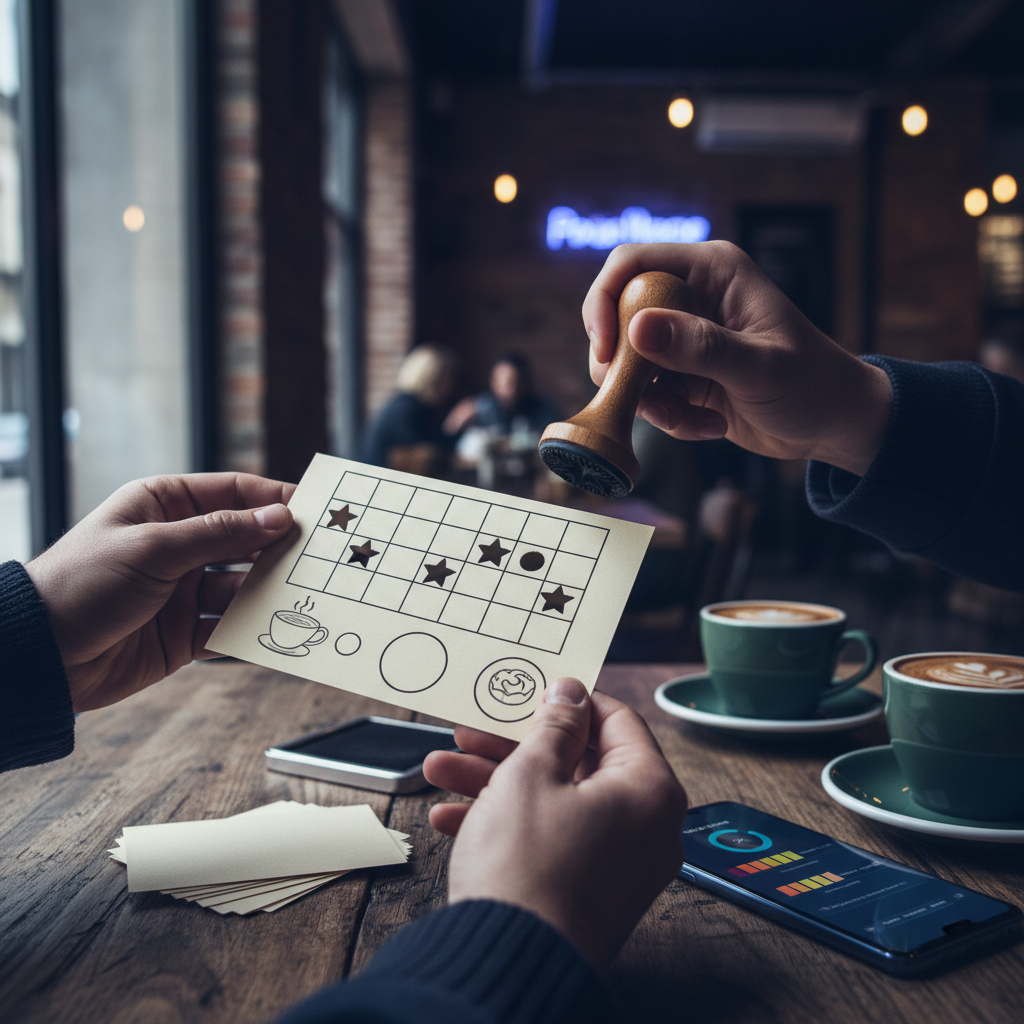
Punch Card Reward System: How to Structure Yours to Actually Drive Repeat Visits
Most small businesses set up a punch card program and call it done: visit 10 times, get 1 free. That is fine as a starting point, but "fine" and "effective" are not the same thing. The structure of your reward system — how many stamps, what the reward is, how you communicate it — has a significant effect on how often customers actually come back. This guide covers what the research and real-world data say about designing a punch card reward system that genuinely increases repeat visit rates.
Build a loyalty program designed to drive repeat visits
Try Loop.fans Loyalty — FreeThe Core Question: What Is the Right Number of Stamps?
Want to replace your paper punch cards with a digital version? Get your free digital punch card — Customers earn stamps on their phone. No app download required.
The most common formats are 9 stamps for a free 10th, or some variation of that ratio. But the "right" number is not the same for every business — it depends on your visit frequency, your average transaction value, and what margin you can afford to give away.
The psychology of progress
Research in consumer psychology (including work from Columbia Business School on what is called the "endowed progress effect") shows that customers who are given a head start on a loyalty card are significantly more likely to complete it. A card that shows "2 of 10 stamps collected" — with the first two already filled in — produces higher completion rates than a card starting at zero.
The practical implication: consider giving new customers their first stamp automatically at enrollment. It is not a revenue cost — the customer has already visited — but it changes the psychological framing from "I'm starting" to "I'm already on my way."
High threshold vs low threshold
A 10-stamp card spreads the reward across more visits, which means lower redemption cost but also lower perceived progress at any given point. A 5-stamp card feels more achievable — customers know they are always close — but costs you more per engaged customer if the reward value stays the same.
General guidelines:
- High-frequency businesses (cafés, quick service food, gyms): 8–10 stamps. Customers visit often enough that the threshold feels achievable within a few weeks.
- Medium-frequency businesses (hair salons, nail salons, restaurants): 5–7 stamps. These customers visit less often, so a lower threshold prevents the card from feeling aspirational rather than achievable.
- Low-frequency businesses (spas, dentists, car services): 3–5 stamps. At low visit frequency, a 10-stamp card is a 2–3 year journey. That is not motivation, it is a joke.
What Kind of Reward Actually Works?
The instinct is to offer a free version of your main product: a free coffee, a free haircut, a free treatment. That is fine, but there are better options depending on your margin and your business type.
Free product rewards
The most common format. Works well when your main product has a high perceived value relative to its actual cost — coffee is the textbook example. A coffee that costs a customer $5 but costs you $1 to make is an excellent loyalty reward. A free haircut that costs you $40 in labour is a different calculation.
Upgrade rewards
"Free upgrade to large" or "free add-on treatment" costs less than the headline product but delivers high perceived value. A nail salon offering a free gel top coat (cost: $2, perceived value: $15) gets the same loyalty effect as a free manicure at a fraction of the cost.
Percentage discount rewards
Discounts are the weakest loyalty reward type because they train customers to wait for the discount rather than building an emotional connection. They also reduce perceived value — a customer who gets 20% off a product worth $50 saves $10, but does not feel the same satisfaction as getting something "free." Use discounts only if your margin makes product rewards impractical.
Experience rewards
For the right business type, experience rewards are disproportionately powerful. A coffee shop that offers "free latte art class for loyalty members" creates a memory and a story — something a free coffee can not match. The cost may be similar, but the loyalty depth is significantly greater.
See how to structure rewards that keep customers coming back
Try Loop.fans Loyalty — FreeHow to Communicate the Program to Customers
The best-designed loyalty program in the world does nothing if customers do not know about it or do not understand it. Here is what works:
The one-sentence pitch
Train your team to explain the program in one sentence at the point of sale: "We have a loyalty program — scan that code and every visit earns you a stamp. 9 stamps gets you a free coffee." That is everything the customer needs to know. Do not over-explain.
Visibility at the point of sale
The QR code or stamp card should be visible and prominent — at eye level, clearly labelled with a brief explanation. Customers who have to ask "what's that code for?" are already less likely to enroll than customers who understand it at a glance.
Progress visibility
Customers are more motivated when they can see their progress. Digital loyalty systems that show "you have 6 of 9 stamps" are more effective than systems that just confirm "stamp added." The gap between current state and reward is a motivator.
Reminder notifications
A notification when a customer is one stamp away from their reward is one of the most effective single mechanics in loyalty program design. It creates urgency — "I'm so close" — and brings customers back who might otherwise drift. This is only possible with digital loyalty programs; paper cards have no notification capability.
Common Structural Mistakes
Setting the reward too far away
A 20-stamp card with a $10 reward is not a loyalty program — it is a discount spread across 20 visits. Most customers will disengage before visit 5. The reward should feel achievable within a timeframe that matches your typical customer visit frequency.
Offering a reward that costs you too much
If your primary product has low margin, offering a free version of it as the loyalty reward destroys your economics. Calculate the actual cost of your reward, not the perceived value. A free espresso shot (cost: $0.30) as a loyalty reward to a café that sells coffee at $4 is excellent economics. A free full-service car wash at $40 cost as a loyalty reward after 10 visits at $15 each is not.
No enrollment momentum
If customers can enroll whenever they feel like it, many will keep meaning to and never do. Creating a small enrollment incentive — "scan now and get your first stamp" — creates an immediate reason to act rather than defer.
Not tracking anything
A paper punch card tells you nothing about your customers. Digital loyalty programs tell you who your regulars are, how often they visit, what time of day they come, and how long the average customer takes to redeem. That data is valuable — use it to improve the program over time.
Real Loyalty Program Examples That Work
The café classic
9 stamps, free coffee reward. Customer gets first stamp free at enrollment. Reminder notification at 8 stamps. Completion rate: typically 35–50% of enrolled customers reach the reward within 3 months.
The salon model
5 visits, free nail art add-on (valued at $15, costs salon $2). Enrolls at booking via text link. Mid-series reminder via SMS at 3 stamps. Works well because the perceived reward value is high relative to actual cost.
The gym check-in system
30 check-ins in 60 days earns a free personal training session or a branded gym bag. Creates a challenge mechanic rather than a simple stamp card — the time boundary adds urgency. Higher average visit frequency in the first 60 days for enrolled members vs non-enrolled.
The boutique model
Points per dollar spent (1 point per $1), 100 points = $10 store credit. Rewards higher-value purchases proportionally. Also offers bonus points for leaving a Google review (20 points) and for referring a friend (50 points). Turns a basic points system into a full engagement program.
Launch your reward system today — free to start
Try Loop.fans Loyalty — FreeBeyond the Punch: Expanding What Gets Rewarded
The punch card reward system is arguably the oldest customer loyalty mechanic in existence. Its appeal is obvious: simplicity, tangibility, and a clear value exchange. Buy ten, get one free. It works because customers understand it instantly, and the physical (or digital) card serves as a visible reminder of progress. But simplicity is also the punch card's limitation. It rewards exactly one behaviour — repeat purchasing — and ignores every other way a customer might contribute to a business.
A customer who brings three friends, posts an enthusiastic review on Google, or shares a photo of their meal on social media delivers value that far exceeds a single purchase. Participation systems expand the reward framework to recognise these contributions. According to customer loyalty statistics, customers who engage with a brand across multiple touchpoints — not just purchases — have substantially higher lifetime value. The punch card captures only a fraction of that potential.
The evolution from punch card to participation platform isn't about abandoning simplicity — it's about layering additional reward dimensions on top of a familiar mechanic. A business might keep the "buy ten, get one free" punch card while also rewarding referrals, content creation, and social sharing. This layered approach is what distinguishes a participation network from a loyalty program: the network creates multiple pathways for customers to contribute and benefit, generating compounding returns that a single-axis punch card cannot. For businesses ready to outgrow the one-dimensional punch model, the participation economy offers a framework that scales with customer ambition.
Frequently Asked Questions
How many stamps should a punch card have?
It depends on your visit frequency. High-frequency businesses (cafés, gyms) work well at 8–10 stamps. Medium-frequency businesses (salons, restaurants) do better at 5–7. Low-frequency businesses should use 3–5. The goal is for the reward to feel achievable within a timeframe that matches how often customers naturally visit.
What is the best reward for a punch card system?
A free version of your main product works well when you have high margin. Upgrade rewards (free add-on, free size upgrade) offer high perceived value at lower cost. Avoid percentage discounts — they train customers to wait for deals rather than building loyalty.
Does the number of stamps affect completion rates?
Yes significantly. Lower stamp targets have higher completion rates. Research on the "endowed progress effect" also shows that giving customers a head start (e.g. first stamp at enrollment) meaningfully increases completion rates versus starting at zero.
Should I use a paper punch card or a digital loyalty program?
Digital systems are more effective in every measurable way — customers can't lose the card, you can send progress reminders, and you get real data on visit frequency and redemption patterns. Paper cards are faster to deploy but produce no data and no way to reach customers between visits.
How do I get customers to actually enroll in my punch card program?
Train your team to explain it in one sentence at every transaction. Make the enrollment point (QR code or card) visible and clearly labelled. Give customers their first stamp immediately at enrollment. These three things typically drive 30–50% enrollment rates among new customers within 60 days of launching.
Getting the most out of punch card reward system: advanced tips and next steps
Audit your reward redemption rate quarterly
A healthy loyalty program has a redemption rate above 30%. If customers are earning but not redeeming, your reward threshold may be too high, your reward options unappealing, or your reminders insufficient. Low redemption often signals high churn risk.
Layer behavioral triggers on top of point accumulation
Points alone are table stakes. The programs that drive real retention add behavioral triggers: a welcome bonus for new members, a bonus for trying a new service category, a milestone reward at 6 months. Each trigger is a reason to return that wouldn't otherwise exist.
Measure program ROI at the cohort level
Don't measure loyalty success by total members. Measure visit frequency of members vs. non-members, average spend per visit, and 12-month retention rate by enrollment cohort. This tells you whether the program is actually changing behavior.
Use your loyalty data for inventory and staffing decisions
If your loyalty program data shows that 40% of your most loyal customers visit on Thursday evenings, that's a staffing and inventory signal, not just a marketing one. Operational decisions informed by loyalty data compound the program's value.
Ready to get started?
Create your free digital punch card — Free forever. Set up in 10 minutes.