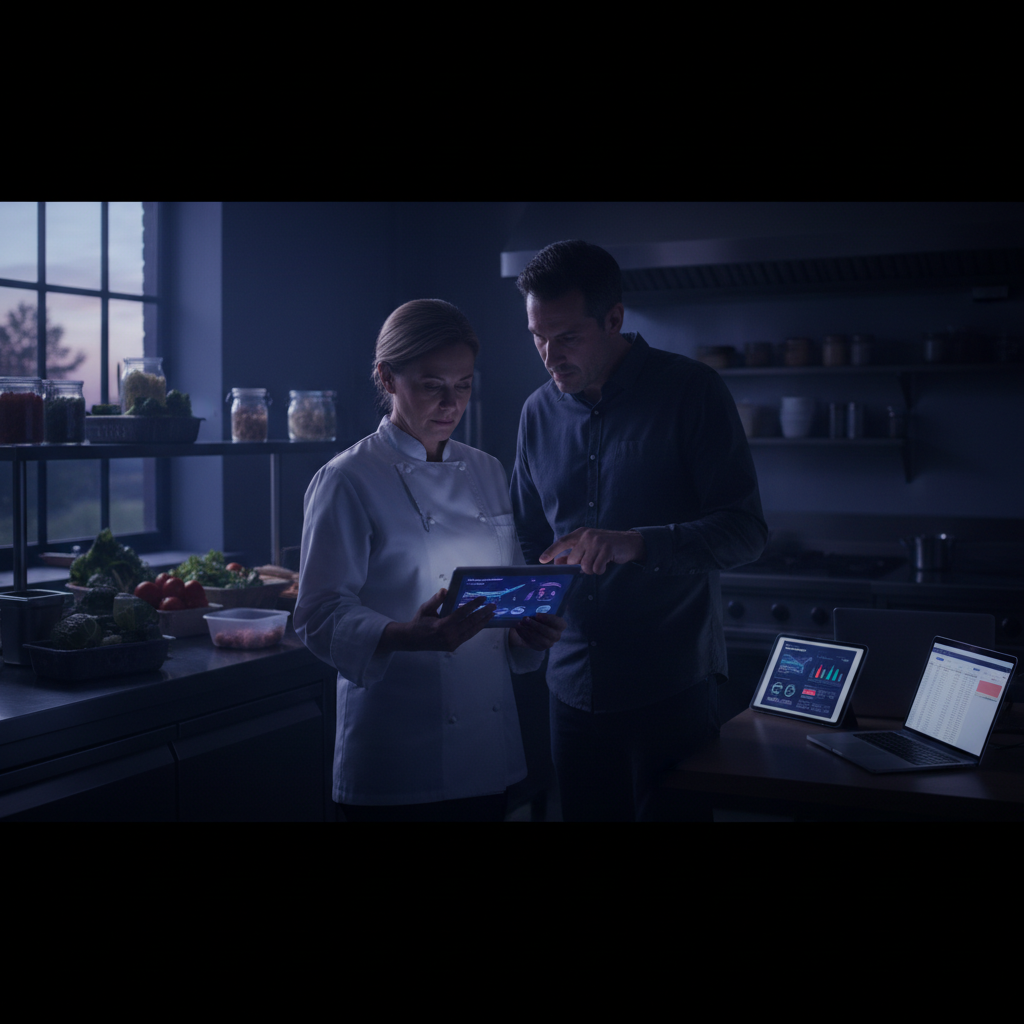
Restaurant Inventory Management Software for Small Brands
**Primary keyword:** restaurant inventory management software Managing food costs is one of the biggest challenges restaurant owners face. Food cost percentage directly impacts profitability, and poor inventory control leads to massive waste. This is where **restaurant inventory management software** becomes essential. In this comprehensive guide, we'll break down why restaurant inventory software matters, when free options are sufficient, which paid solutions deliver real value, and how the best tools connect to your POS and loyalty systems. We'll also explore who truly needs enterprise-level software versus who can get by with simpler tools. ## Why Restaurant Inventory Software Matters Restaurants operate on thin margins. The average food cost percentage for full-service restaurants hovers between 28-35%. Every percentage point saved goes straight to the bottom line. **Key benefits of proper inventory management:** - **Waste reduction**: Track usage patterns and expiration dates to minimize spoilage - **Accurate ordering**: Know exactly what you need to order based on historical sales data - **Cost control**: Identify menu items that are costing more than they should - **Compliance and traceability**: Maintain records for food safety regulations - **Real-time visibility**: Know stock levels across multiple locations instantly Without good **restaurant inventory management software**, owners rely on manual counts and spreadsheets — processes that are time-consuming and prone to human error. The result is often over-ordering, stockouts during peak times, or throwing away expired ingredients. Studies show restaurants lose 4-10% of revenue to inventory waste. For a restaurant doing $1M in annual sales, that's $40,000-$100,000 vanishing each year. ## Free Options and When They're Enough Many small restaurants start with basic tools that are completely free. **Spreadsheets (Google Sheets/Excel):** - Perfect for single-location operations with limited menu items - Manual but free - Works well when you have time to do daily counts - Can be enhanced with simple formulas for par levels and reorder points **Basic POS built-in inventory:** - Many modern POS systems include rudimentary inventory tracking - Good for tracking what sells but often weak on receiving and waste tracking - Free with your POS subscription **Free or freemium tools:** - Some inventory apps offer limited free tiers - Suitable for operations under $500k annual revenue with simple menus **When free is enough:** - Single location with fewer than 50 menu items - Owner or manager has time for daily manual counts - Low waste categories (mostly dry goods, limited perishables) - Stable menu that doesn't change frequently If you're spending more than 2 hours per week on inventory or noticing consistent discrepancies between expected and actual costs, it's time to consider paid solutions. ## Paid Options Compared: Price vs Features The **restaurant inventory management software** market offers solutions at various price points. Here's a breakdown of what you're actually paying for: ### Entry-Level Paid Solutions ($50-150/month) These tools focus on core inventory tracking: - Real-time stock levels - Basic par level alerts - Simple reporting - Mobile apps for receiving goods Best for: Small independent restaurants, cafes, quick-service operations **What to look for:** - Easy integration with your existing POS - Barcode scanning support - Recipe costing features - Waste logging capability ### Mid-Tier Solutions ($150-400/month) These provide more sophisticated features: - Advanced recipe management with ingredient substitution tracking - Supplier integration and automated ordering - Multi-location support - Detailed analytics and food cost reporting - Variance analysis (theoretical vs actual usage) Best for: Growing restaurant groups, full-service restaurants with complex menus ### Enterprise Solutions ($500+/month) These are comprehensive platforms that often include: - AI-powered demand forecasting - Full supply chain management - Advanced analytics dashboards - Integration with accounting systems - Custom reporting and API access - Dedicated account management Best for: Large restaurant chains, high-volume operations, multi-concept groups ## Who Needs Enterprise vs Who's Fine With a Spreadsheet **You can probably stick with basic tools if:** - Single location - Under $750k annual revenue - Simple menu (under 75 items) - Low complexity ingredients (minimal made-from-scratch items) - Owner actively involved in operations **You should invest in proper restaurant inventory management software if:** - Multiple locations - Complex recipes with many ingredients - High volume of perishable items - Food costs consistently above target - Growing rapidly or planning to expand - Multiple managers who need visibility into inventory The sweet spot for most independent restaurants is a mid-tier solution that connects to their POS. This provides 80% of the benefit of enterprise software at 30% of the cost. ## The Tools That Connect Inventory to Your POS The real power comes when your **restaurant inventory management software** talks to your POS system in real-time. **Key integrations to look for:** - **Sales data sync**: Automatic deduction of ingredients based on what was sold - **Recipe management**: Linking menu items to ingredient usage - **Theoretical vs actual food cost**: Identifying where waste or theft is occurring - **Bidirectional sync**: Pushing inventory levels back to the POS for menu item 86'ing Popular POS systems with strong inventory integrations include Toast, Square, Lightspeed, and TouchBistro. The best **restaurant inventory management software** solutions have pre-built connectors for these platforms. When inventory and POS are connected properly, you get: - Automatic stock updates from sales - Real-time alerts when items are running low - Accurate food cost calculations - Better forecasting based on actual sales patterns ## Making the Right Choice for Your Restaurant Choosing the right **restaurant inventory management software** depends on your specific needs: **For most independent restaurants:** Look for a solution that offers: - POS integration - Recipe costing - Mobile receiving - Waste tracking - Basic reporting - Reasonable monthly cost (under $250) **For growing chains:** Prioritize: - Multi-location management - Advanced analytics - Supplier portals - API access for custom needs - Strong forecasting tools **Questions to ask potential vendors:** 1. How long does implementation typically take? 2. What kind of training and support do you provide? 3. How does your system handle recipe changes and ingredient substitutions? 4. Can I see a demo with my actual menu items? 5. What does your customer support look like outside of business hours? ## Beyond Inventory: Connecting to the Full Customer Experience Managing costs effectively is just the first step in building a successful restaurant. The real competitive advantage comes when you combine strong operations with excellent guest experiences. That's where tools like Loop.fans come in. While **restaurant inventory management software** helps you control costs on the back end, bringing customers back repeatedly is what drives sustainable growth. Loyalty programs, user-generated content rewards, and fan engagement tools help turn one-time visitors into regulars and advocates. **Managing costs is step one. Bringing customers back is step two — that's where Loop comes in.** By connecting your operational tools (inventory, POS) with your customer relationship tools (loyalty, UGC rewards, marketing), you create a complete system that optimizes both the back of house and the front of house. ## Taking Action Start by evaluating your current inventory process: - How much time are you spending on inventory counts weekly? - What is your actual food cost percentage versus your target? - How much waste are you seeing each month? - Are you able to identify which menu items are most profitable? If the answers to these questions suggest inefficiency, it's time to explore **restaurant inventory management software** options. Begin with a solution that integrates with your POS, offers mobile capabilities, and provides clear reporting on food costs and usage. Implement it for your highest cost or highest volume items first, then expand as you see results. The restaurants that thrive in competitive markets are those that master both sides of the equation — controlling costs while building customer loyalty. Get your inventory under control, then focus on giving customers reasons to keep coming back. Ready to see how Loop can help you build customer loyalty alongside your operational improvements? [Explore Loop.fans loyalty and rewards tools](https://loop.fans/products/loyalty-rewards). *Internal links for SEO:* - [Restaurant Loyalty Programs: The Complete Guide](/blog/restaurant-loyalty-programs-complete-guide) - [Customer Loyalty Program Software for Restaurants](/blog/customer-loyalty-program-software-restaurants) - [How Restaurant Loyalty Programs Drive Revenue](/blog/restaurant-loyalty-programs-roi-revenue-guide) (Word count: ~1650)The Tools That Connect Inventory to Your POS
Want to calculate the ROI of launching a loyalty program? Try our free loyalty ROI calculator — See the revenue impact in minutes — input your own numbers.
Managing restaurant inventory in isolation — tracking usage manually and reconciling against your POS sales report at the end of the week — creates significant lag between what's happening in your kitchen and what you know about it. POS-integrated inventory tools close that gap by connecting sales data directly to inventory depletion, so you know what you're running low on before service rather than during it.
The tools worth knowing:
- MarketMan: Deep integration with major restaurant POS systems (Toast, Square, Lightspeed). Tracks inventory by recipe — a burger sold at the POS automatically depletes the beef, bun, lettuce, and sauce from your inventory. Provides waste tracking, vendor ordering integration, and cost-of-goods reporting. Best for restaurants with standardized menus. Pricing starts around $200/month.
- BlueCart: Focuses on the ordering and vendor management side of inventory — digitizes your purchase orders, tracks deliveries, and connects vendor pricing to your cost calculations. Less comprehensive on the POS-depletion side but excellent for managing the purchasing workflow that most independent restaurants still handle via phone and fax. Free tier available for basic ordering.
- Toast Inventory (built-in): If you're on Toast POS, the built-in inventory tracking is functional for most small restaurants without additional software cost. Tracks theoretical vs. actual usage, generates variance reports, and integrates naturally with your existing Toast setup. The trade-off is that it's less powerful than dedicated inventory platforms — no automated purchasing, limited waste tracking granularity.
- Craftable (formerly Bevager/Foodager): Particularly strong for bars and restaurants with complex beverage programs. Handles both food and alcohol inventory with the detailed pour tracking and variance analysis that beverage costs require. Integrates with most major POS systems.
The ROI of POS-integrated inventory comes from two sources: reduced food costs (typically 2–4 percentage points when variance is actively managed) and reduced administrative time (typically 3–5 hours per week freed from manual inventory counting and ordering).
Managing Costs Is Step One — Bringing Customers Back Is Step Two
Inventory management solves the cost side of restaurant profitability. But sustainable profitability requires both controlled costs and reliable revenue — and reliable revenue in an independent restaurant depends on repeat customers.
The math is straightforward: reducing food cost by 3 percentage points on $50,000 monthly revenue saves $1,500/month. Increasing customer return visits by 20% on $50,000 monthly revenue adds $10,000/month. Both matter, but the revenue lever is significantly larger than the cost lever for most independent restaurants.
Building repeat customer systems is where most independent restaurants underinvest. The tools available are simpler and less expensive than restaurant inventory software:
- A digital loyalty program that gives customers a reason to return specifically to your restaurant rather than cycling through options — visit-based stamp programs and points programs both work well for restaurants. Loop.fans handles this with no app download required for customers, which is critical for independent restaurants where asking customers to download a new app creates friction that kills adoption.
- An email list that lets you communicate directly with your regular customers — weekly specials, seasonal menu changes, private dining availability, and loyalty program updates keep your restaurant top of mind between visits. A restaurant with 500 engaged email subscribers can fill a slow Tuesday night with a single email.
- A referral program that rewards your existing regulars for bringing new customers — word-of-mouth is already your best acquisition channel; a formal customer referral program makes it systematic and trackable.
The restaurant operators who achieve long-term profitability are the ones who treat both cost control and customer retention as ongoing systems — not one-time fixes. For more on the customer retention side, see restaurant loyalty programs and how to increase repeat customers.
Ready to get started?
Start free on Loop.fans — Free loyalty tools for businesses of every size.