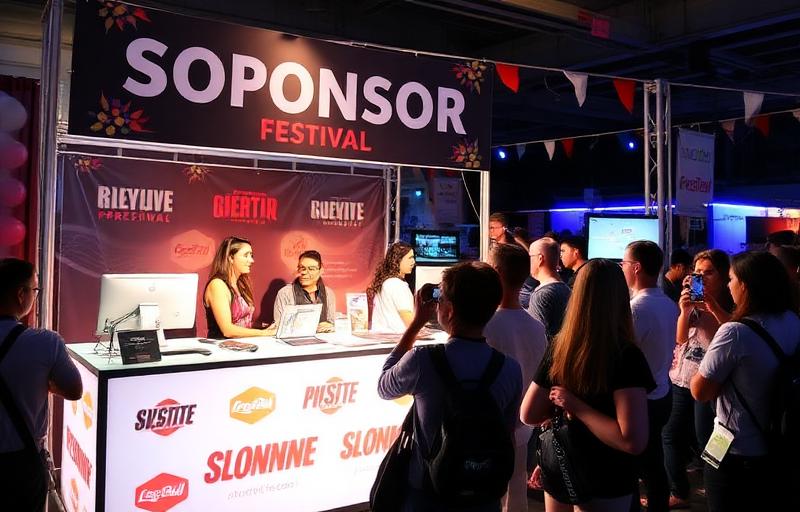
Sponsorship Activation Through Attendee Engagement
Beyond Logo Placement
Want to grow your business without increasing ad spend? Explore Loop.fans free tools — Loyalty, referrals, UGC, and more — free to start.
Modern sponsorship activation integrates sponsors into the attendee experience through engagement mechanics.
Build a loyalty program your customers will actually use
See Loop.fans Loyalty & RewardsSponsored Challenges
Sponsor-branded challenges within the loyalty program generate measurable interactions.
Content Co-Creation
Photo booths, content stations, and themed challenges generate authentic content serving both festival and sponsor.
Data and Attribution
Loyalty data provides sponsors with detailed engagement metrics and sentiment analysis.
Sponsor Retention
Engagement-integrated sponsorship achieves 80-90% retention vs 50-60% for traditional models.
Why Sponsorship Activation Through Attendee Engagement matters in a broader growth strategy
Sponsorship Activation Through Attendee Engagement should not sit in isolation. The strongest content on Loop.fans works when it helps readers understand how one tactic connects to acquisition, retention, referrals, community participation, and long-term audience value. That is especially true for sponsorship activation attendee engagement, because readers are rarely looking for a definition alone. They want practical context, real trade-offs, and a clearer view of how the idea fits into an actionable marketing or audience-growth system.
When teams treat sponsorship activation attendee engagement as part of a wider participation engine, they usually get stronger results. Instead of publishing one-off campaigns or disconnected tips, they create repeatable motions that encourage audiences to return, contribute, and move deeper into the relationship. That can include content participation, loyalty rewards, referral prompts, creator collaboration, or community-led distribution. The exact mix depends on the brand and category, but the common thread is that the audience is no longer passive.
How to evaluate execution quality
A good core topic article should help a reader move from curiosity to implementation. That means explaining what success actually looks like, what mistakes to avoid, and what signals matter when measuring performance. For a topic like sponsorship activation attendee engagement, surface-level summaries are not enough. The more useful approach is to break the subject into decision points, workflows, and outcomes that a real operator can use.
- Clarity: the reader should understand what the concept means and where it fits.
- Practicality: the advice should be specific enough to apply, not just inspirational.
- Measurement: the article should connect the topic to retention, conversion, participation, or revenue.
- Strategic fit: the content should show how the topic supports a repeatable audience-growth system.
Common mistakes and better alternatives
One common mistake is treating sponsorship activation attendee engagement as a stand-alone fix. Teams often expect a single tool, campaign, or content format to solve a broader growth problem. In practice, sustainable results come from orchestration. The topic needs to connect with messaging, incentives, distribution, and follow-up actions. Another mistake is optimizing for vanity metrics rather than business outcomes. Reach, impressions, and clicks may matter, but they are only helpful when they lead to durable engagement and clearer customer value.
A better approach is to map the topic to a short list of actions that can be repeated and improved over time. Start with one strong use case, document the workflow, track the response, and then expand. That gives the team a way to learn without overcomplicating the first rollout. It also makes the content more useful because the guidance is grounded in execution rather than abstraction.
What readers should take away
The real value of Sponsorship Activation Through Attendee Engagement is not just understanding the term. It is understanding how to apply it in a way that compounds. Readers who are evaluating this topic usually want better growth efficiency, stronger audience loyalty, and more predictable results from their marketing effort. The most effective strategy is to connect the concept to a repeatable participation model that makes the audience more likely to engage again.
This expansion pass is focused on closing a meaningful word-count gap while improving depth, clarity, and usefulness. That means the article should now do a better job of answering follow-up questions, supporting internal linking, and reinforcing the page as a stronger long-term SEO asset.
Recommended next steps for operators
After reading a page like this, the next move should be obvious. Review how the topic shows up in the current customer journey, identify where participation is weak or inconsistent, and then choose one measurable workflow to improve first. That may be a referral prompt, a loyalty mechanic, a content collection flow, or a community activation loop. Starting with one focused implementation path makes it easier to learn quickly and improve performance without overcomplicating the rollout.
From there, the goal is consistency. Strong results tend to come from steady iteration rather than one dramatic campaign. Teams that treat this topic as part of a repeatable operating system are usually the ones that turn interest into retention, advocacy, and compounding audience value over time.
Understanding Sponsorship Activation Through Attendee Engagement in context
Sponsorship Activation Through Attendee Engagement is one of those topics that looks simple on the surface but rewards deeper exploration. For creators and brands operating on Loop.fans, the context matters as much as the concept. Knowing what sponsorship activation attendee engagement means is just the entry point — the real value comes from understanding when it applies, how it interacts with other tactics, and what a high-quality execution actually looks like versus a low-effort attempt that delivers minimal return.
Free loyalty program — no app download needed for customers
See Loop.fans Loyalty & RewardsAudiences have become skilled at recognizing generic content. When a page genuinely unpacks a topic with specificity and actionable depth, it builds trust in a way that shallow summaries simply cannot. That trust compounds over time: readers bookmark, return, share, and link. For sponsorship activation attendee engagement specifically, the depth of coverage directly affects how useful the page is for someone actually trying to implement or evaluate the concept in a real context.
Why sponsorship activation attendee engagement matters for audience-driven growth
Growth on creator platforms is rarely linear. The most effective strategies tend to build participation systems — environments where audiences have reasons to return, contribute, and deepen their connection to a creator or brand. Sponsorship Activation Through Attendee Engagement fits into this framework by addressing one specific pressure point in that system. Whether it improves discovery, retention, monetization, or community engagement depends on how it is applied, but the underlying principle is consistent: sustainable growth comes from compounding audience behavior, not one-off spikes.
When sponsorship activation attendee engagement is treated as an isolated tactic, results tend to be modest and hard to repeat. When it is integrated into a broader strategy — one that connects content, community, and conversion — the outcomes tend to be meaningfully better. The teams that do this well are usually the ones that understand not just what the tactic does, but how it fits into the larger system they are building.
Common implementation mistakes and how to avoid them
The most frequent mistake with sponsorship activation attendee engagement is treating it as a one-time effort rather than an ongoing practice. A single campaign, post, or feature rollout rarely moves the needle significantly on its own. The compounding effect that makes these strategies valuable comes from consistency — repeated execution, measurement, refinement, and integration with the rest of the creator's or brand's presence on the platform.
A second common mistake is optimizing for the wrong metric. Vanity numbers — raw impressions, follower counts, surface-level engagement — can look good while the underlying business metrics remain flat. For sponsorship activation attendee engagement, the metrics that matter are usually tied to retention, repeat engagement, conversion, and audience lifetime value. Setting those as the primary success criteria from the start forces clearer thinking about what execution actually needs to look like.
- Mistake 1: Running a single activation and moving on before results can compound.
- Mistake 2: Measuring success by reach or impressions instead of retention and conversion.
- Mistake 3: Treating sponsorship activation attendee engagement in isolation instead of integrating it with adjacent content and community tactics.
- Mistake 4: Skipping the documentation step — what worked, what did not, and why.
Practical execution framework for Sponsorship Activation Through Attendee Engagement
Effective execution of sponsorship activation attendee engagement usually follows a recognizable pattern regardless of the specific context. The first step is definition: what specific outcome does this tactic need to drive, and what does success look like in measurable terms? The second step is baseline: what is the current state, and what would a meaningful improvement look like within a realistic timeframe? The third step is activation: what is the minimum viable version of this tactic that can be tested quickly and inexpensively?
From there, the pattern is iteration. Run the activation, measure against the defined success criteria, identify what worked and what did not, and refine before the next cycle. Over time, this process builds an institutional understanding of how sponsorship activation attendee engagement performs in a specific context — which is far more valuable than any generic best-practice framework. The goal is not to follow a playbook; it is to develop one that is specific to the audience, platform, and creator or brand in question.
Documentation is the step most teams skip, and it is also the step that separates teams that improve over time from those that repeat the same mistakes. After each activation, capture the key decisions, the results, and the one or two things that would be done differently next time. This does not need to be elaborate — a short internal note is enough. The habit of capturing it is what matters.
Measuring success with Sponsorship Activation Through Attendee Engagement
Measurement for sponsorship activation attendee engagement should be tied directly to the outcome the tactic is meant to drive. If the goal is retention, the relevant metric might be return visit rate, content completion rate, or subscription renewal. If the goal is acquisition, it might be referral rate, organic search visibility, or conversion from first visit. If the goal is community depth, it might be comment rate, user-generated content volume, or participation in loyalty or reward programs.
The trap to avoid is using a proxy metric as if it were the primary outcome. Impressions and reach are proxies for awareness, not outcomes in themselves. Time on page is a proxy for engagement, not a direct measure of value delivered. These proxies can be useful signals, but they should be held loosely and evaluated in the context of the outcomes they are supposed to predict. When proxies and outcomes diverge — high reach, low conversion, for example — that divergence is usually telling you something important about the quality of the execution or the relevance of the audience.
See also: Festival UGC: How Attendee Content Sells Next Year's Tickets
Start your loyalty program today — free
See Loop.fans Loyalty & RewardsAlso on Loop.fans: Launch your event's digital presence with our AI website builder for festivals and events — with ticketing, loyalty, and community tools built in.
Implementing Sponsorship Activation Attendee Engagement for Maximum Impact
Successfully adding sponsorship activation attendee engagement requires a strategic approach that aligns with your overall business goals. Start by auditing your current customer journey to identify the best integration points. For restaurants, this might mean placing QR codes prominently on tables or creating a seamless online reservation flow directly from your website. For events and festivals, focus on mobile-first experiences that encourage real-time participation.
Key best practices include ensuring mobile responsiveness, integrating with your existing loyalty or CRM systems, and providing clear calls-to-action. Test different designs and messaging with a small audience before full rollout. Track metrics such as engagement rate, conversion to sign-ups, repeat visits, and customer feedback to measure success.
Real-World Examples and Case Studies
Many successful brands have leveraged similar strategies to boost engagement and retention. Consider how major sports teams use fan engagement platforms to maintain year-round connection through loyalty programs, gamified apps, and personalized offers. Restaurants using AI-powered QR menus have seen significant increases in data collection and repeat business by offering personalized recommendations based on past orders.
Festivals that implemented volunteer reward systems and post-event communities report higher attendee satisfaction and return rates. Tourism operators using destination loyalty programs see improved repeat visitation by rewarding cultural experiences and local business partnerships. These examples demonstrate that thoughtful implementation of loyalty, engagement, and digital tools delivers measurable ROI.
Choosing the Right Tools and Platforms
When selecting tools for sponsorship activation attendee engagement, prioritize platforms that offer easy integration, robust analytics, and scalability. Look for solutions with strong mobile support, customizable templates, and seamless connections to your website or POS system. Free and freemium options can be great starting points for small businesses, while enterprise features like advanced segmentation and automation suit larger operations.
- Integration capabilities: Ensure compatibility with your current tech stack.
- Analytics and insights: Access to dashboards that show real performance data.
- Customer support: Responsive help when you need to troubleshoot or optimize.
- Cost-effectiveness: Balance features with your budget — many tools offer generous free tiers.
Compare options like specialized QR menu generators, website builders with booking widgets, or comprehensive customer engagement platforms to find the best fit.
Future Trends in Customer Engagement and Loyalty
The landscape is evolving rapidly with AI personalization, gamification, UGC integration, and data-driven experiences becoming standard. Expect more emphasis on purpose-driven loyalty that aligns with customer values, seamless omnichannel experiences, and privacy-first data collection. Brands that stay ahead by adopting these trends will build stronger communities and more resilient revenue streams.
Whether you're a restaurant owner looking to modernize your menu and reservations, a festival organizer building year-round fan connection, or a hospitality group implementing coalition loyalty, focusing on genuine value and exceptional experiences will differentiate you in a competitive market.
Getting the most out of sponsorship activation attendee engagement: advanced tips and next steps
Audit your reward redemption rate quarterly
A healthy loyalty program has a redemption rate above 30%. If customers are earning but not redeeming, your reward threshold may be too high, your reward options unappealing, or your reminders insufficient. Low redemption often signals high churn risk.
Layer behavioral triggers on top of point accumulation
Points alone are table stakes. The programs that drive real retention add behavioral triggers: a welcome bonus for new members, a bonus for trying a new service category, a milestone reward at 6 months. Each trigger is a reason to return that wouldn't otherwise exist.
Measure program ROI at the cohort level
Don't measure loyalty success by total members. Measure visit frequency of members vs. non-members, average spend per visit, and 12-month retention rate by enrollment cohort. This tells you whether the program is actually changing behavior.
Use your loyalty data for inventory and staffing decisions
If your loyalty program data shows that 40% of your most loyal customers visit on Thursday evenings, that's a staffing and inventory signal, not just a marketing one. Operational decisions informed by loyalty data compound the program's value.
Ready to get started?
Start free on Loop.fans — No contract. No tech team. Ready in minutes.